Power of Attorney (POA) for India from the USA – Complete Step-by-Step Guide (2026)
If you live in the United States but need someone in India to handle your property, banking, legal, or personal matters, a Power of Attorney (POA) is one of the most important legal documents you can prepare.
This guide explains the process, required documents, notarization, apostille, and common mistakes to avoid.
What is a Power of Attorney?
A Power of Attorney (POA) is a legal document that authorizes another person (your “Attorney-in-Fact” or “Agent”) to act on your behalf.
If you cannot travel to India, a POA allows a trusted individual to complete transactions for you.
Common uses include:
- •Selling or purchasing property
- •Managing inherited property
- •Signing real estate documents
- •Operating bank accounts (where accepted)
- •Handling court matters
- •Applying for utility transfers
- •Managing rental properties
Types of Power of Attorney
General Power of Attorney (GPA)
Authorizes your representative to perform a broad range of legal and financial activities.
Special (Specific) Power of Attorney (SPA)
Grants authority only for a specific transaction, such as:
- •Selling one property
- •Registering a deed
- •Appearing before a specific government office
A Special POA is generally preferred whenever possible because it limits the authority granted.
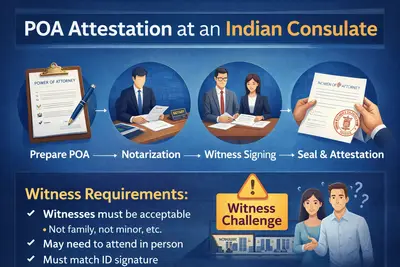
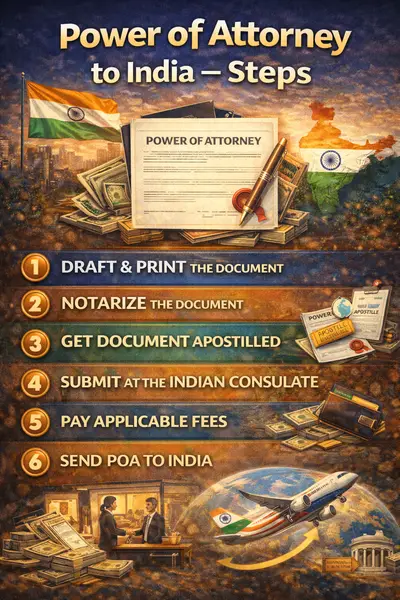
Step 1: Prepare the POA
The document should clearly identify:
- ✓Principal (person granting authority)
- ✓Attorney-in-Fact (person receiving authority)
- ✓Purpose of the POA
- ✓Specific powers granted
- ✓Property details (if applicable)
- ✓Date and signatures
Every Indian state may have slightly different wording requirements, so it is advisable to prepare the document carefully.
Step 2: Sign Before a California Notary Public
If you are in California:
- ✓Bring valid government-issued identification.
- ✓Sign the POA before a California Notary Public.
- ✓The notary completes the required acknowledgment certificate.
The notary verifies your identity but does not verify or draft the legal content of the document.
Step 3: Obtain an Apostille
Since both the United States and India are members of the Hague Apostille Convention, an apostille is generally accepted in place of embassy legalization for most purposes.
The notarized document is submitted to the California Secretary of State for an Apostille certificate.
This authenticates the notary’s signature for use in India. Learn more on our Apostille Services page or FAQ.
Step 4: Send the Original to India
After the Apostille is attached:
- ✓Send the original document to your representative in India using a reliable courier service.
- ✓Keep scanned copies for your records.
Step 5: Adjudication or Registration in India
Depending on the Indian state and the purpose, your representative may need to:
- •Pay applicable stamp duty
- •Present the POA before the local Sub-Registrar
- •Complete adjudication within the prescribed time
- •Register the POA if required
Requirements vary by state.
Documents Typically Required
- ✓Draft Power of Attorney
- ✓Valid Passport
- ✓Government-issued Photo ID
- ✓Proof of U.S. Address (if required)
- ✓Property details (for property transactions)
Frequently Asked Questions
Does the POA have to be notarized?
Yes. The signature should generally be notarized before obtaining an Apostille.
Is an Apostille required?
For most documents intended for use in India, yes.
Is the Indian Embassy or Consulate required?
For many situations, an Apostille is sufficient because both countries participate in the Hague Apostille Convention. However, individual organizations or authorities may have their own document requirements.
Can one POA be used for multiple properties?
Yes, if properly drafted. However, many people choose a property-specific POA for additional clarity.
Can I revoke a POA?
Yes. A Power of Attorney can generally be revoked at any time unless it is irrevocable under applicable law. The revocation should be communicated to the attorney-in-fact and any relevant authorities.
Common Mistakes to Avoid
- ✗Using vague property descriptions
- ✗Forgetting required notarization
- ✗Sending photocopies instead of originals
- ✗Granting broader authority than necessary
- ✗Missing required adjudication or registration deadlines in India
Need Help?
At Gale Ranch Notary, we assist clients with:
- •Power of Attorney document preparation (at your direction)
- •California notarization
- •California Apostille processing
- •Document shipping to India
- •General guidance on the process
If you’re preparing a Power of Attorney for India, contact us for assistance with the document preparation and notarization process.
Govind Gopal
Gale Ranch Notary & Financial Services
Contact Us SubscribeLeave a Comment
Your email address will not be published. Required fields are marked *